



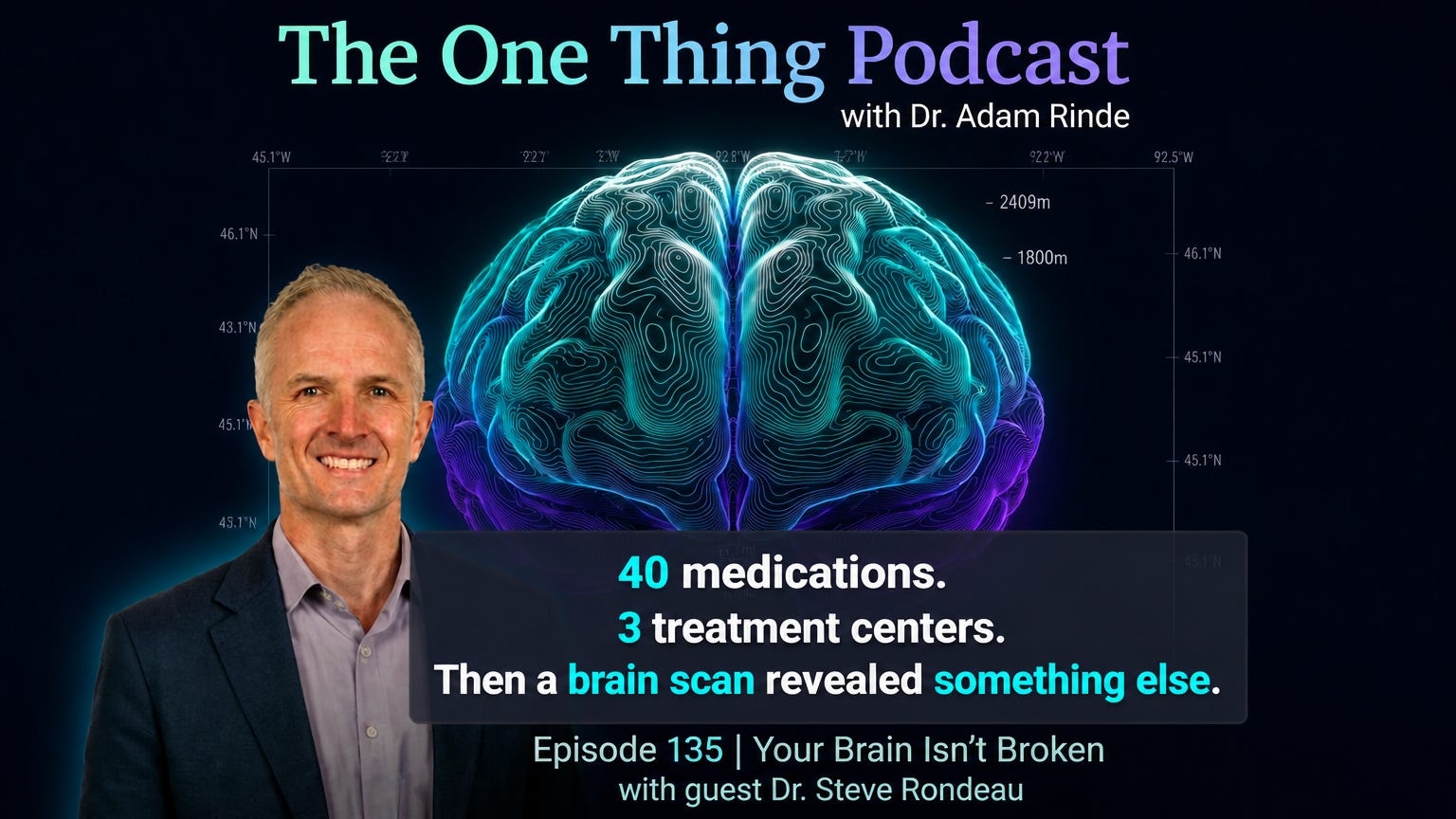
There’s a pattern I see often in my own practice.
A patient arrives with a stack of diagnoses — depression first, then anxiety, then ADHD, sometimes bipolar — each one a slightly different label, each tied to a treatment that didn’t quite work.
The internal narrative becomes some version of “if I just got the right diagnosis, then I’d know the right treatment.”
It’s an intuitive belief. It’s also, by the numbers, mostly wrong.
Here’s the data that doesn’t get talked about much: the correlation between an accurate psychiatric diagnosis and a favorable treatment outcome is weak. Even when ten experts agree on a diagnosis, that agreement doesn’t predict who gets better. So the loop continues — another provider, another label, another medication trial — and the structural reason it continues is rarely surfaced inside the appointment itself.
That’s the conversation I had with my latest guest on One Thing*: Dr. Steve Rondeau, a naturopathic physician who’s spent the last fifteen years analyzing qEEG brain scans — about 50,000 of them — and asking a different question than the one psychiatry typically asks. Not “what’s wrong with this person,” but “what brain pattern is showing up here, and what environment would actually fit it?”*
His reframe is one I’ve been thinking about all week. He calls it the Husky Phenomenon.
A husky in Arizona looks depressed. Amotivated. Lethargic. If a clinician evaluated the dog in that environment, they might reach for a medication. The same husky in Colorado — running through snow, in his element — looks fine. Better than fine. The dog isn’t broken. The climate is.
Rondeau’s argument, backed by the heterogeneity hiding inside labels like “depression” or “ADHD” once you actually look at the brain data, is that many of the patterns we call disorders aren’t disorders at all. They’re brain patterns mismatched to the environments they’re being asked to function in. The clinical question shifts: not “how do we fix this brain,” but “what environment does this brain actually fit in, and can we move it closer to that?”
I want to be clear about what this is and isn’t. It isn’t a dismissal of conventional psychiatric medicine. Sometimes medications are exactly the right answer. Sometimes therapy is. Sometimes the data points somewhere else entirely — a head injury, a heavy metal exposure, an autoimmune process showing up as a psychiatric symptom. The point isn’t natural-good-conventional-bad. The point is that the diagnostic question we’re starting with — does this person fit one of these labels — may not be the most useful question to start with.
If you’ve been in the diagnosis-chasing loop, or you love someone who has, this is the conversation I most wanted to have on the show this year.
🎧 Listen to the full episode here: [link to episode]
About Dr. Rondeau
Dr. Steve Rondeau is the founder of Axon EEG Solutions and the author of the forthcoming book Think Like a Brain*, out at the end of March. An award-winning naturopathic physician, he began his career in developmental pediatrics looking for objective biomarkers in autism — the experience that shaped his core conviction that mental health deserves the same kind of measurable data the rest of medicine takes for granted. Over fifteen years and more than 50,000 qEEG brain scans later, he’s best known for what he calls the Husky Phenomenon: the idea that many of the brain patterns we label as disorders aren’t broken at all, just mismatched to the environments they’re being asked to function in.*
Connect with Dr. Rondeau Website: axoneegsolutions.com Book: thinklikeabrain.com LinkedIn: Dr. Steven Rondeau


